➕ 6th Grade Math · Unit 1
Area and Surface Area
11 short narrated lessons in 2 chapters, each with pictures, a quiz with a hint and a second try, and an explanation for every answer.
Standards: 6.G.A.1 6.G.A.4

What your child will learn
Area of polygons
- Slide It Into a Rectangle: Area of ParallelogramsFind the area of a parallelogram by cutting and rearranging it into a rectangle, then multiplying base times height.
- Half a Parallelogram: Area of TrianglesFind the area of a triangle as one half of base times height by seeing it as half of a parallelogram.
- Take It Apart: Area of TrapezoidsFind the area of a trapezoid by splitting it into triangles and rectangles.
- Add It or Subtract It: Area of Any PolygonFind the area of any polygon by breaking it into rectangles and triangles, or by subtracting pieces from a larger shape.
- Area Detective: Polygons Review ReviewReview finding the area of parallelograms, triangles and other polygons.
Nets and surface area
- Faces, Edges and VerticesDescribe prisms and pyramids by their faces, edges and vertices.
- NetsMatch a three-dimensional figure to a net that folds up to make it.
- Surface Area of PrismsFind the surface area of a rectangular or triangular prism by adding the areas of the faces in its net.
- Surface Area of PyramidsFind the surface area of a pyramid by adding the area of its base and its triangle faces.
- Nets and Surface Area Review ReviewReview using nets to find surface area.
- Unit 1 Test: Area and Surface AreaShow what you learned in the whole unit (Area of polygons, Nets and surface area) by answering mixed questions.
Try a question from this unit
From the lesson “Slide It Into a Rectangle: Area of Parallelograms”
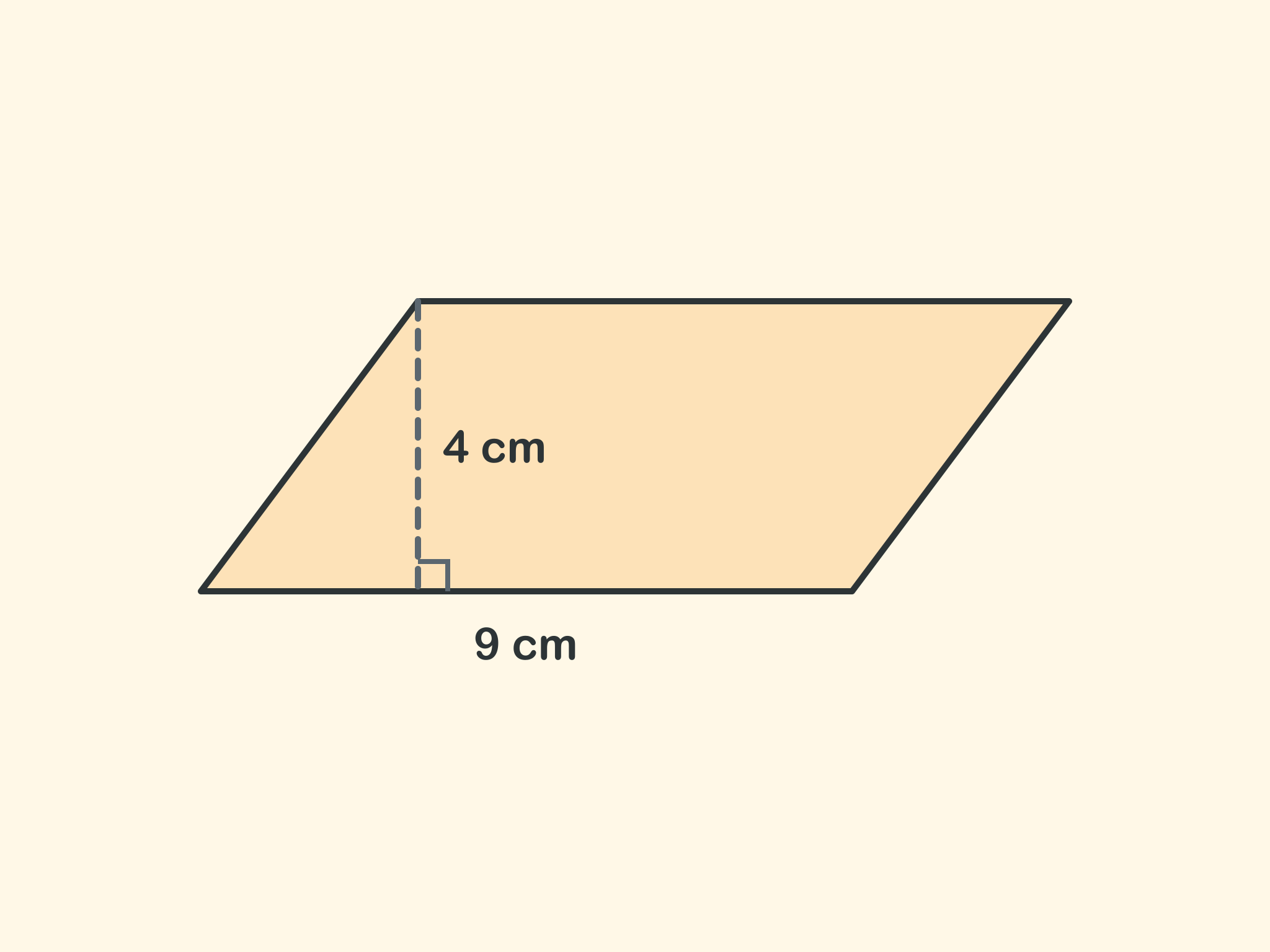
A parallelogram has a base of 9 centimeters and a height of 4 centimeters. What is its area?
Show the answer
36 square centimeters. The area of a parallelogram is base times height. 9 × 4 = 36, so the area is 36 square centimeters.
Hint kids see after a wrong try: “Multiply the base by the height.”
Key words
- parallelogram
- base
- height
- triangle
- one half
- trapezoid
- decompose
- polygon
- compose
- prism
- pyramid
- face
- net
- three-dimensional
- surface area
- lateral face
Try these lessons in Kids Shelf
Narrated lessons, pictures and quizzes for every grade from K to 8. Works offline.